
👋 First, thank you to everyone who responded to my call last week for volunteer experts. I haven’t replied to each of you yet, but know that I appreciate it and will be in touch. For those who missed it, you can always join in: If you’re an expert in something, anything, let me know. We cover a lot of topics at The Outlier and are always looking for a second opinion on things we’re not necessarily experts in. Volunteer to help us here (no obligation or commitment required).
📈 Over the past few weeks we’ve been focused on finalising datasets and charts for a new release of DataDesk. This week we published the 100th dataset/chart combination in DataDesk, and we still have a few hundred in the pipeline. The full version of DataDesk is not yet generally available, but we are testing with a few users and we’re still looking for a few more testers. So if you’re a teacher, journalist, researcher or academic, please get in touch.
👇🏾 In today’s newsletter we look at:
- Passenger rail returns to pre-Covid levels
- Cost of a healthy diet
- Joburg rubbish goes to private landfills
- Salary inequality at SA’s state-owned enterprises
🛤️ Back on track
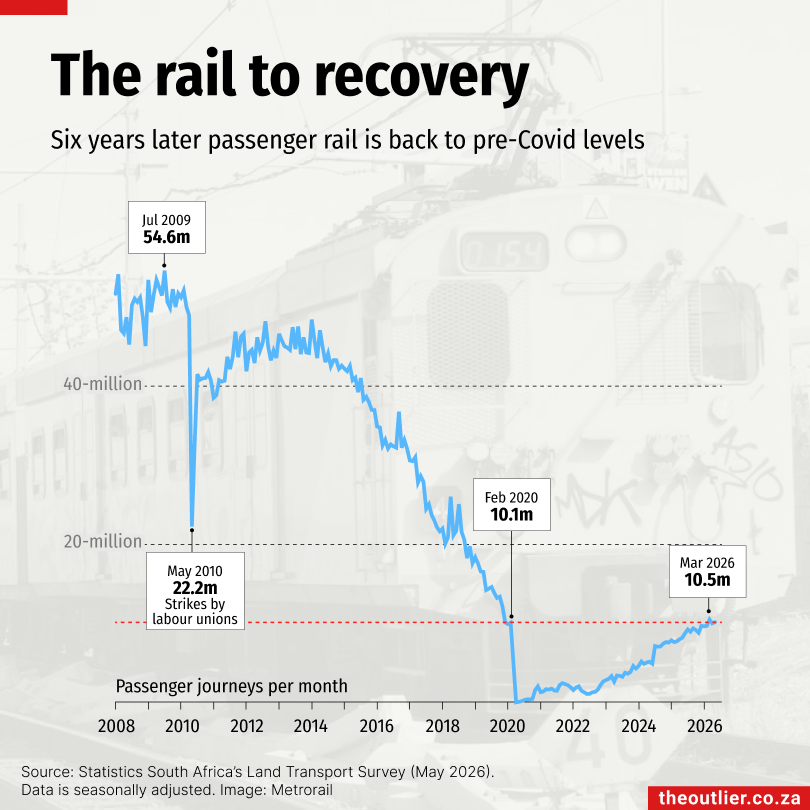
South Africa’s passenger rail trips are now back up to levels last seen before the Covid-19 lockdown. A month before the lockdown, in February 2020, there were 10.1-million monthly passenger rail trips, according to Stats SA’s Land Transport Survey.
Six years on March 2026 recorded 10.5-million trips, the highest monthly total since the lockdown ended.
What’s driving it? The Passenger Rail Agency of South Africa (Prasa) has restored services on 35 of its 40 train lines, though only around 70% are running a full service. Prasa has also grown its rail fleet from 96 to 134 trains, according to its 2024/25 annual report.
Even so, trips remain roughly a fifth of their historic peak of 54.6-million, set in July 2009, seventeen years ago. Prasa’s 2019/20 annual report links the earlier drop in passenger trips to vandalism and theft of rail infrastructure, following the termination of national security contracts around October 2019 and December 2019. The vandalism and theft of infrastructure was exacerbated during the 2020 lockdown.
🍊 Eat right
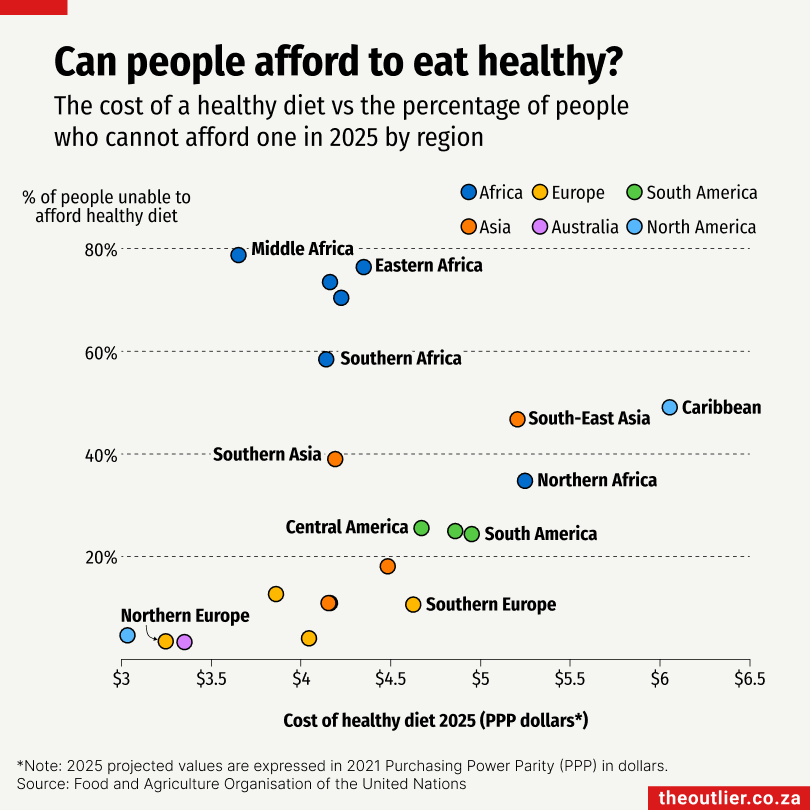
The cost of a healthy diet varies across the world, but higher food costs don’t necessarily mean a healthy diet is unaffordable, and lower food costs don’t guarantee it’s within reach.
Data from the Food and Agriculture Organisation shows that despite having food costs close to the global average, most of Africa struggles to afford a healthy diet. In 2025, the average cost of a healthy diet in Africa was $4.35 per person per day. It was just above the world average of $4.28, yet 66.6% of people in Africa couldn’t afford one. In Middle Africa specifically, the cost was $3.65, and 78.7% of the population still couldn’t afford a healthy diet.
By contrast, in Northern America and Europe had an even lower average cost ($3.64) than the global average, and 6.8% of the population couldn’t afford a healthy diet.
The Caribbean had one of the highest food costs in the data ($6.04), and 48.9% of its population couldn’t afford a healthy diet.
🗑️ Rubbish woes
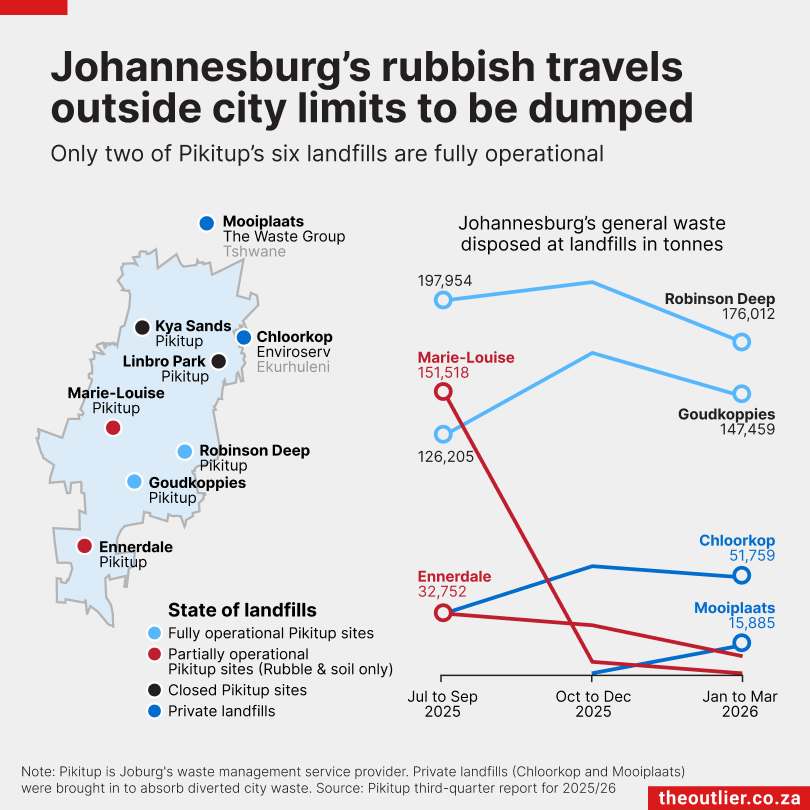
Johannesburg’s landfill problem has reached crisis levels.
Only two of the city’s four municipal landfills, Robinson Deep and Goudkoppies, are still fully operational. But even those are nearly full: Robinson Deep is 99% full, Goudkoppies 96%. Ennerdale is only accepting builders’ rubble and soil, and Marie Louise has effectively shut its gates and taken in zero tonnes of general waste between January and March 2026, down from over 150,000 tonnes just two quarters earlier. Marie Louise is also physically overfull, by 773,973 cubic metres, according to the last landfill airspace survey conducted in October 2025.
Pikitup is reinforcing Marie Louise’s boundary wall and has plans to expand its capacity, but the wall project has stalled because the contractor hasn’t been paid. It’s a familiar refrain across the entity’s infrastructure projects. And this isn’t new: Pikitup’s landfills have been flagged for near-capacity since at least 2020.
To keep up with the roughly 150,000 tonnes of waste Johannesburg generates each month, the city relies on two privately operated landfills outside its borders, which handled 17% of all disposed waste between January and March 2026.
But dumping further afield comes at a cost: Pikitup’s 2025/26 quarter three report warns that relying on private landfills carries a real “operational, logistical and financial impact”, and that plans to expand its own landfills should be sped up as a result. It also warns that service failures, from long queues to missed rounds to illegal dumping, are likely to worsen the longer this continues.
Produced in partnership with Our City News.
💰 Salary gap
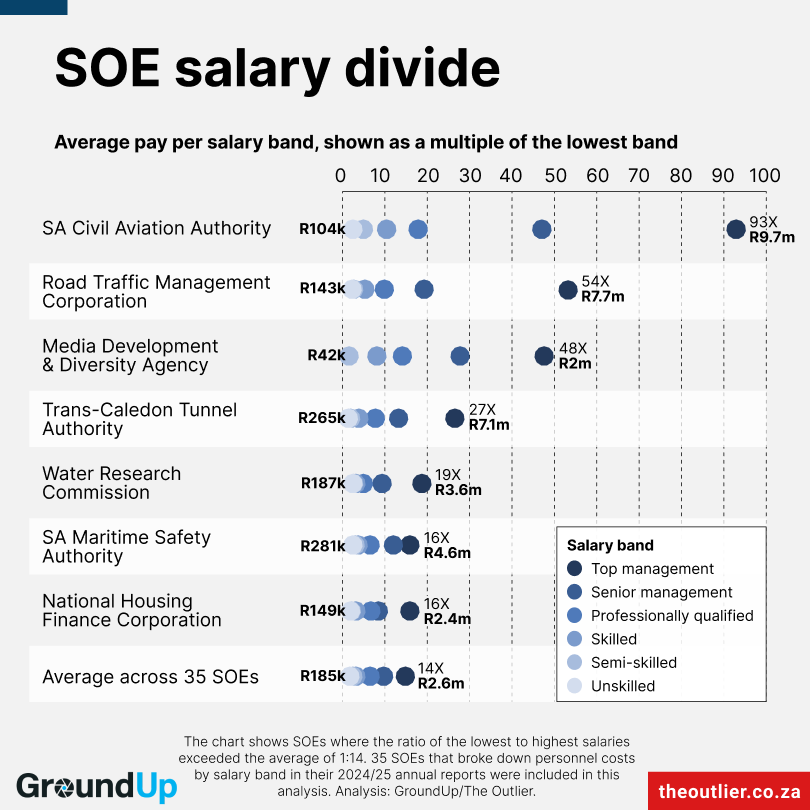
The Outlier and GroundUp analysed the pay inequality at 35 state-owned enterprises (SOEs) and found that, on average, top managers earn about 14x as much as the lowest-paid employees.
These SOEs were the ones which reported their pay structures by salary band: unskilled, semi-skilled, skilled, professionally qualified, senior management, and top management.
We found seven entities with an above-average gap between the lowest and highest number of employees. These are not the entities with the highest top salaries; they are those with the highest income inequality among employees.
The CEO at the SA Civil Aviation Authority, which regulates the aviation sector, earned R9.7-million on average in 2024/25. That’s 93x the average annual salary of the 102 workers in the lowest salary band, which was R104,000.
The Road Traffic Management Corporation’s CEO was paid R7.7-million, almost 3x what those in the next highest salary scale earned on average (R2.7-million), and 53x the average pay of the lowest salary band (R143k).
The vast majority of the entity’s 1,706 employees are semi-skilled and earned R240,000 on average.
Read the full GroundUp article here.
Click here for a link to all references for this newsletter.