Today we’re launching our first ever Outlier membership drive to get to 200 paying members by 30 January 2026 (200 in 50 days). We’ve also updated our membership options to make it more affordable to become a core supporter while adding more value to the more costly memberships.
Over the past four years we’ve given away hundreds of charts for free and published 150 newsletters and a dozen tools. Unfortunately we don’t have a stash of funding cash to continue giving everything away for free, so we’ve been rethinking the future of The Outlier. That future is a mix of support from readers like yourself, corporate sponsorships and advertising, and new products like our Outlier Renew reports (Pro members get these reports for free).
I believe we’ve built something unique and interesting in The Outlier and we now need to find a way to secure its future. We can’t do this alone. Your support is hugely important. Become a supporting member today to help us get to 200 members.
📚 Reading gap
Today we’re also publishing one of the longest features we’ve ever done looking at new research into school literacy in South Africa including more than a dozen new charts. The depth of the literacy problem in South African education is daunting but the new research pinpoints some key areas that might hold the key to the solution. Read the summary below and then read the full report here.
📚 R.e.a.d.i.n.g
New research has highlighted both the depth of the problem with child literacy in South African schools – and pathways to solutions.
Teams of linguists and data analysts have researched the skills and markers that show how children learn to read in each of the 11 official languages. This helped to establish reading benchmarks for each of the foundation phase grades.
Then the department conducted a survey, the Funda Uphumelele National Survey (FUNS), which assessed 27,838 learners in 710 public schools across all the provinces and in all 11 languages, and measured the percentage of children who reach the critical reading benchmarks by the end of grade 1, 2 and 3.
The results were released in November. Below are three charts from a longer story we produced with the support of the Henry Nxumalo Foundation.
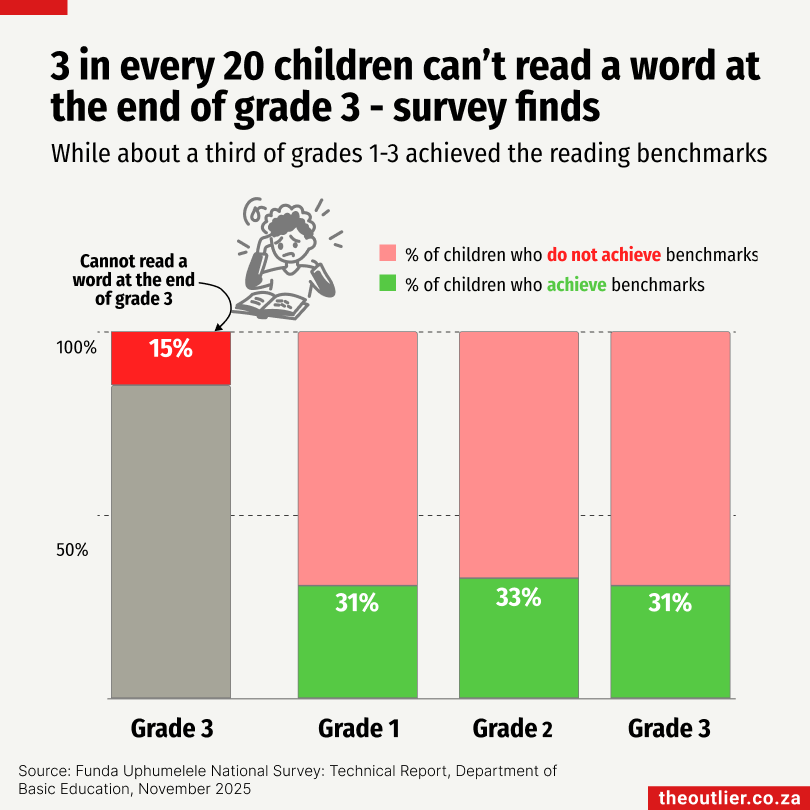
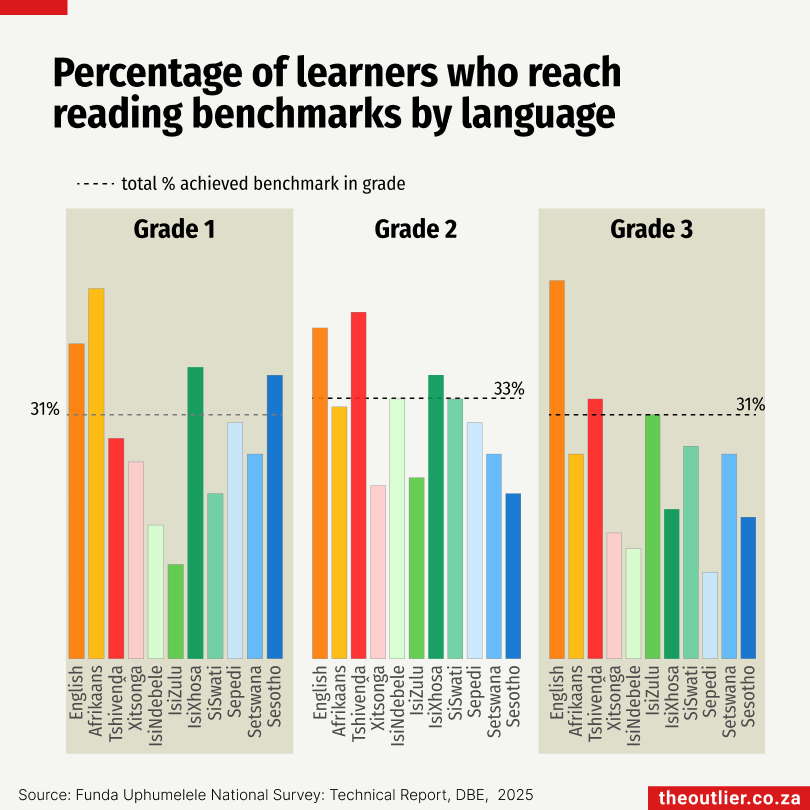
The children who were assessed in English were the most likely to reach the reading benchmarks for all three grades.
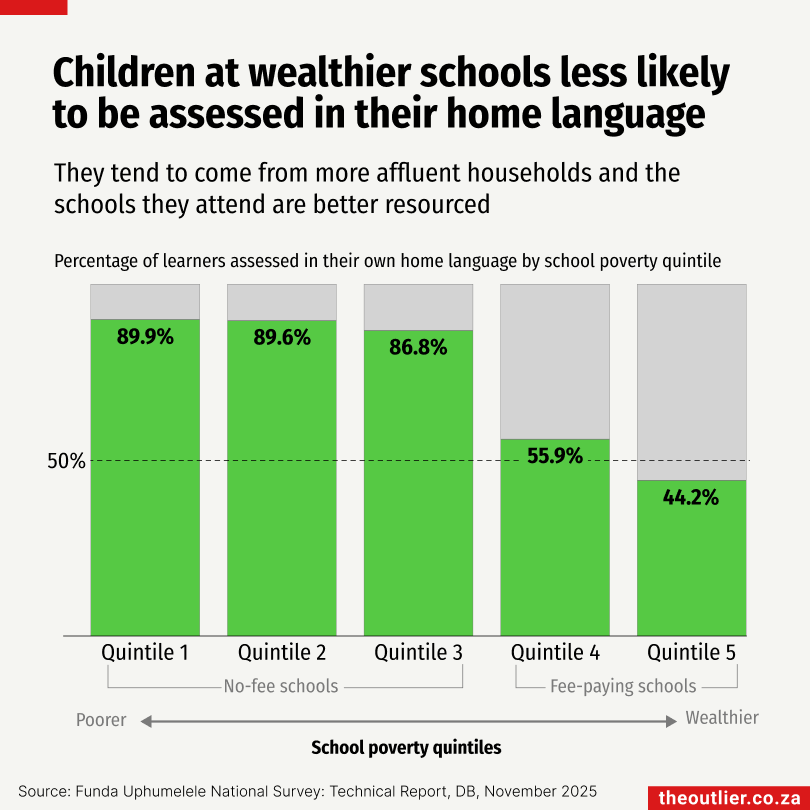
But socio-economic factors play a part. Children at schools in better off areas (the quintile 4 and 5 schools) did better in the reading assessments, even though they were less likely to be taught in their home language in those schools.
Why does this survey matter? The Funda Uphumelele work has made it possible to identify which parts of reading are not successful in each grade and there are now clear measurable benchmarks for reading in 11 languages and each grade that include skills that can be taught using proven methods.
🔋 REIPPPP what you sow
Since 2011, the government has run seven REIPPPP bid windows and contracted more than 11 GW of renewable capacity. So far, 60% of that (or 6.785 GW) has been built and is adding electricity to the grid. That includes all the projects in the first four bid windows and five of the bid window 5 projects.
Wind projects account for 53% of this installed capacity (3.623 GW), followed by solar PV at 46% (3.112 GW). The remaining 1% comes from small biogas and hydro projects.
Most of the projects are in the Northern Cape (3.563 GW or 53%), followed by the Eastern Cape (1.496 GW) and the Western Cape (1.097 GW).
Three solar projects that were part of the Risk Mitigation IPPPP started operating in 2023, adding 0.15 GW.
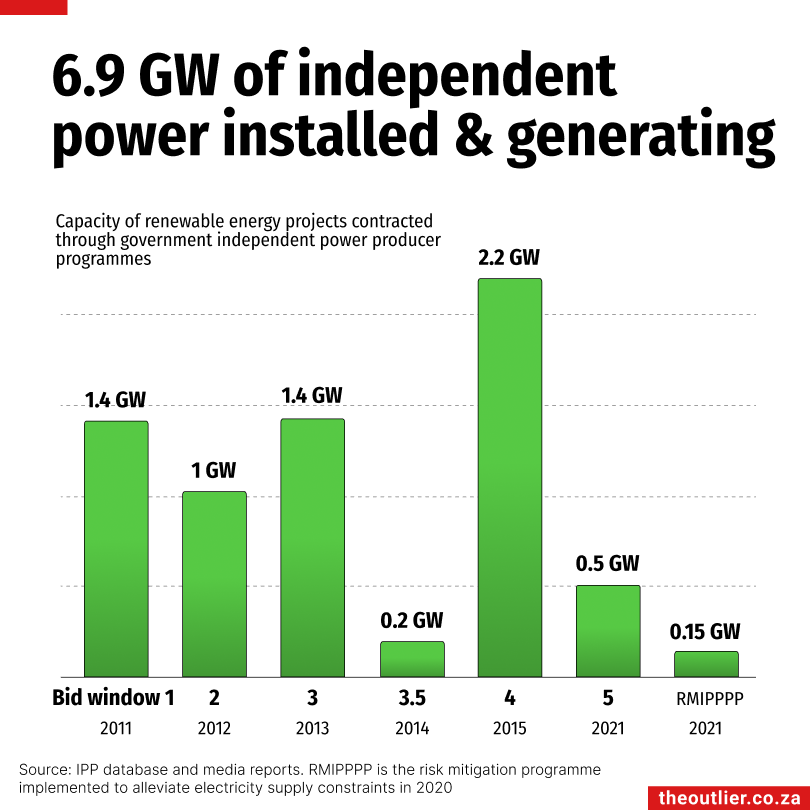
Subscribe to the Outlier Renew newsletter for weekly renewable energy updates.
🚨 Unsolved
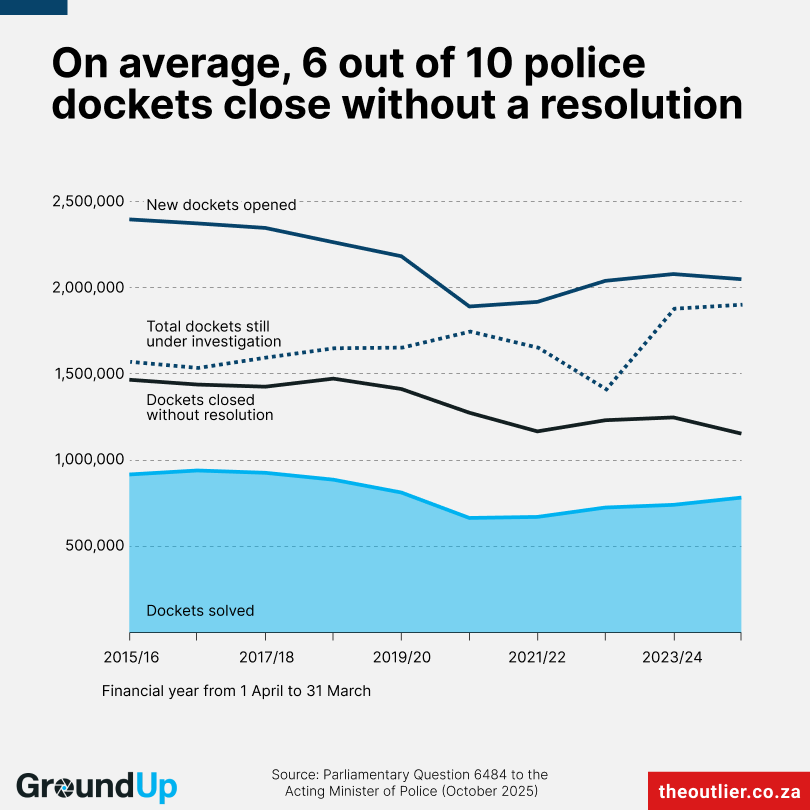
The South African Police Service is drowning in dockets it is struggling to solve.
For every ten dockets the police close every year, an average of 6 are closed without resolution, the Minister of Police revealed in a reply to Parliament in October.
About 2.04-million new dockets were opened in the 2024 financial year, and 1.93-million were closed.
780k cases were solved, but 1.15-million had no resolution.
By the end of the year, the police service still had a total of 1.9-million cases open and under investigation. These include cases from previous years that have still not been closed. The number of open cases has been steadily increasing since 2015, when there were 1.5-million.
Dockets closed without resolution “can be reopened if, for example, new evidence emerges,” the police minister said.
The number of dockets opened every year saw a sharp drop between 2019 and 2021. Though the number has risen since then, it is still lower than it was in 2019. Criminologist at Stellenbosch University, Guy Lamb, says this is likely because of the decriminalisation of cannabis possession.
Chart produced by The Outlier in partnership with GroundUp.