
📢 How do you measure a good life?
The Gauteng City-Region Observatory’s Quality of Life survey has been trying to answer that question in Gauteng since 2009: blending hard numbers on housing, income and services with softer signals on satisfaction, safety and belonging.
On 29 April at 1pm, Christian Hamann takes us behind the data to show how the GCRO team turns seven survey waves into a living portrait of the city region.
Free live. Recording for Outlier members. Questions ahead of time to gemma.ritchie@theoutlier.co.za.
🛜 Connected
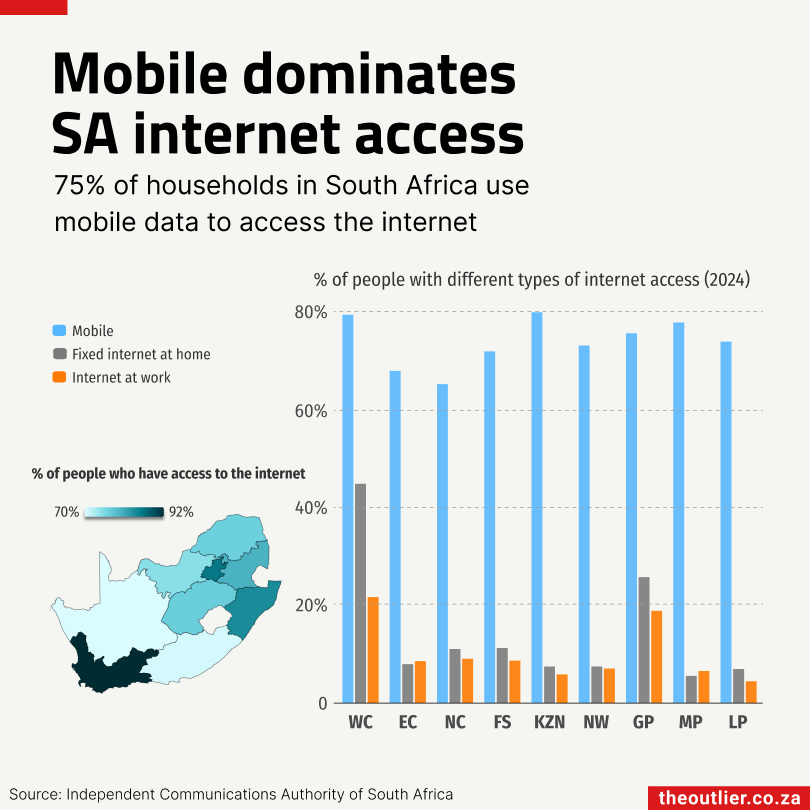
While 82.1% of South Africans have access to the internet in some form, data from the State of the ICT Sector 2026 Report put out by ICASA, shows that internet usage is heavily dominated by mobile connectivity. In 2024, over 75% of South Africans accessed the internet via mobile data, with KwaZulu-Natal recording the highest usage at 80% and the Northern Cape the lowest at 65.3%.
In contrast, the next most used form of internet access, fixed internet access at home remains significantly limited, with only 17.4% of the population having a regular home connection. Regional disparities are also pronounced in this category, with the richer provinces such as the Western Cape showing the highest level of fixed internet access at 44.9%, while provinces such as Mpumalanga (5.6%), Limpopo (7.0%), KwaZulu-Natal (7.5%), North West (7.5%) and Eastern Cape (8%) record the lowest. These figures highlight a clear digital divide in South Africa, where mobile internet overwhelmingly outweighs fixed-line connectivity as the dominant mode of access.
This dominance of mobile connectivity is also reflected in the telecommunications revenue structure. In 2024, mobile services generated over R132-billion, accounting for approximately 56.9% of total telecommunications revenue, while fixed internet services just contributed over R34-billion, or about 15% of total revenue.
📱 Data power
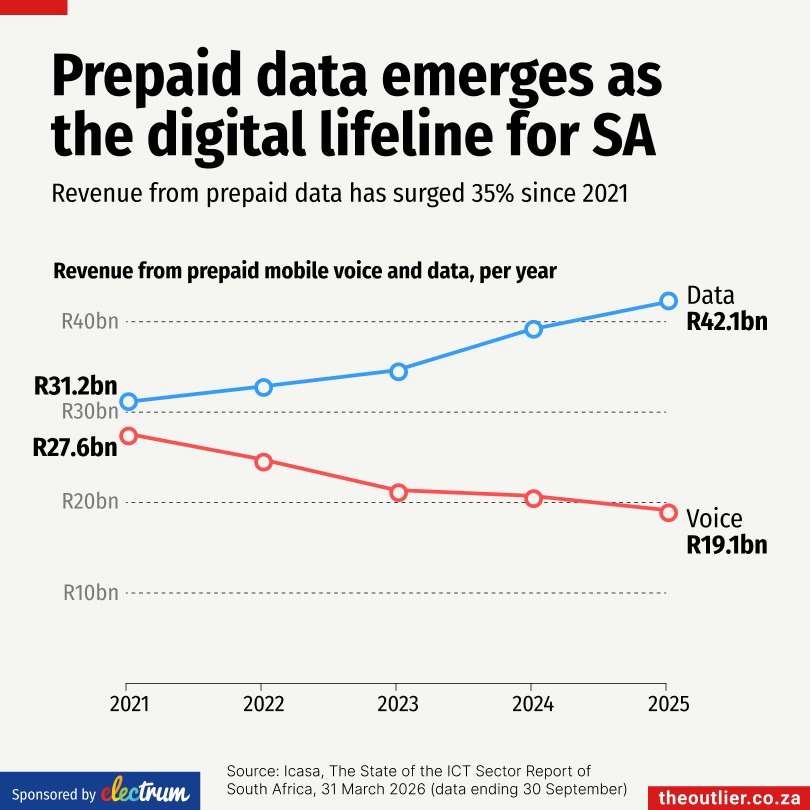
South Africa is witnessing a fundamental evolution in how consumers stay connected. According to the Independent Communications Authority of South Africa’s 2026 State of the ICT report, the traditional “top-up” is being redefined by a sophisticated shift in purchasing behaviour.
While prepaid mobile voice revenue adjusted to R19.1-billion in 2025 as users migrated toward digital communication, this change signals a deeper integration into the digital economy rather than a market slowdown. Consumers are increasingly prioritising data-centric connectivity, with prepaid mobile data revenue surging 35% over four years – climbing from R31.2-billion in 2021 to R42.1-billion in 2025.
This “data-first” preference is driven by the essential role mobile connectivity now plays in daily life. Subscribers are actively choosing larger data bundles to power:
- Digital Financial Services: High-frequency use of mobile banking.
- Educational Growth: Sustained participation in online learning.
- Entertainment & Connection: A rise in streaming and social media engagement.
The hardware market is adapting to support this digital transition. Entry-level smartphones have become more accessible, with prices dropping 20% to approximately R399 in 2025, effectively lowering the barrier for new users. Simultaneously, demand for premium devices remains high, with top-tier models reaching R76,999, reflecting a segment that continues to invest in ultra-advanced technology.
For businesses, this underscores a clear opportunity: as South Africans move toward a comprehensive “Prepaid Airtime and Data” model, providing seamless access to these digital “lifelines” is more critical than ever.
To learn more about South African consumers’ purchasing behaviour, download Electrum’s latest research, State of VAS in South Africa Factsheet.
- Produced by The Outlier in partnership with Electrum, the next-generation payments software company, powering payments for banks and retailers.
🎙️ How to improve economic decision-making
Most of the numbers that describe South Africa’s economy are technically public. Extracting a clean time series from the PDFs, spreadsheets and scattered dashboards they’re published in is another story.
That was the starting point for our Out to Lunch conversation this week with Dr Daan Steenkamp, chief executive of Codera Analytics and the person behind the daily stream of economic charts on your LinkedIn feed. We got into:

- Why the friction between published and usable data is holding South African analysis back
- How Codera’s EconData platform centralises and auto-updates economic data using an open international standard
- The “vintage” problem — why economic data that gets revised after the fact trips up forecasters, and what storing every version lets you see about Treasury’s debt projections
- Real-time indicators for house prices, food inflation and producer prices built from private-sector data, and where they go wrong
- Why Steenkamp is cautious about AI
- The public data that’s legally meant to be published and isn’t — and why it matters
Read the summary story here. Outlier members can also watch the full recording here.
💰 Got registered
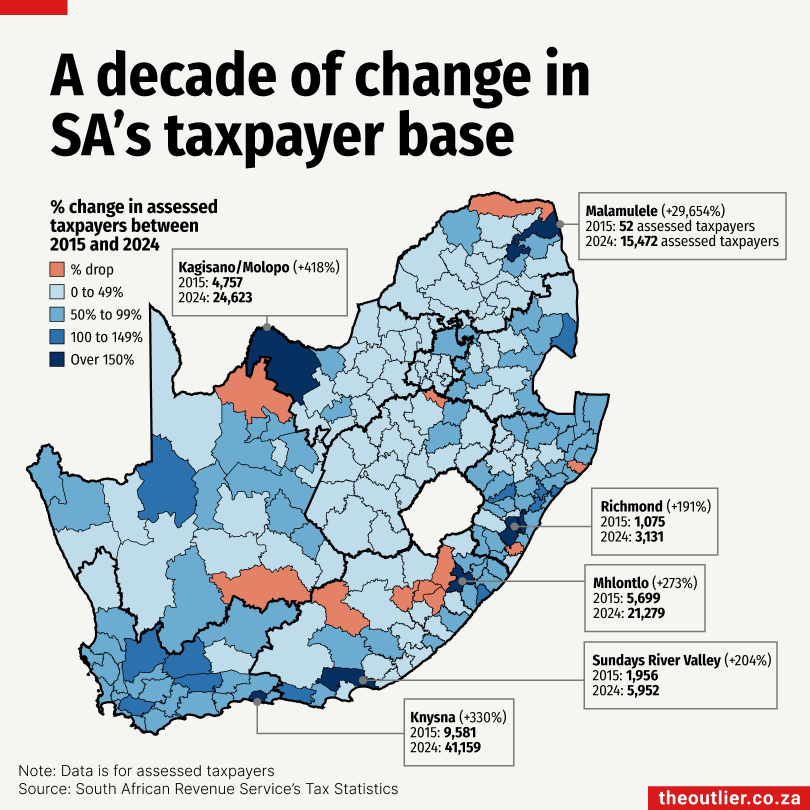
In Limpopo, Malamulele’s assessed taxpayers grew from 52 to 15,472 in a decade. This dramatic rise is largely explained by a 2020 South African Revenue Service policy requiring employers to register all employees for pay-as-you-earn tax, regardless of whether they earned below the tax threshold. Between 2019 and 2020 alone, the municipality’s taxpayer count jumped from 1,837 to 9,292. Richmond’s +191% rise likely reflects the same policy shift.
On the southern coast, Knysna tells a different story. The town quadrupled its assessed taxpayers between 2015 and 2024, with the sharpest jump occurring between 2022 and 2023, likely driven by remote work migration. Notably, average taxable income there has barely shifted over the decade, from R230,143 to R259,948. Kagisano and Mhlontlo saw similarly sharp spikes in the same period, though neither policy nor migration offers an obvious explanation.
Not all growth is concentrated in smaller municipalities. Johannesburg, Tshwane and Cape Town recorded increases of 40%, 51%, and 57% respectively, suggesting economic opportunity continues to draw people toward South Africa’s major urban centres.
⛽️ Diesel woes
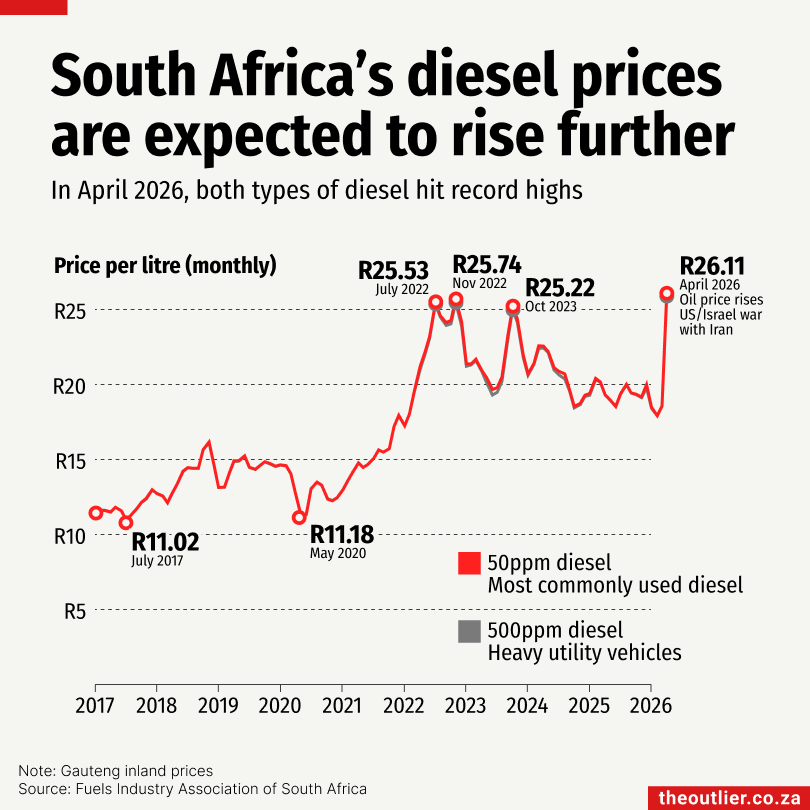
South Africa’s diesel price is set for another painful increase in May, driven by the ongoing US-Israel war against Iran and its knock-on effect on global oil markets.
Fuel prices already surged at the start of April, with diesel increasing by R7.51 per litre in Gauteng, pushing the wholesale price to R26.11. The government cushioned the blow with a temporary R3 per litre cut to the General Fuel Levy, running from 1 April to 5 May 2026.
That relief is about to expire. According to the Central Energy Fund (CEF), if oil prices hold at current levels, a further diesel increase of around R9 per litre is likely in May, according to BusinessTech, putting retail prices around R35 per litre, assuming the levy relief is extended. If it isn’t, prices could climb even higher.
The root cause is the war. US and Israeli strikes on Iran at the end of February caused Iran to retaliate and close the Strait of Hormuz, disrupting global oil supply. Brent crude, which peaked around $110 per barrel in early April, has since eased to around $97.
🧑⚖️ Overdue
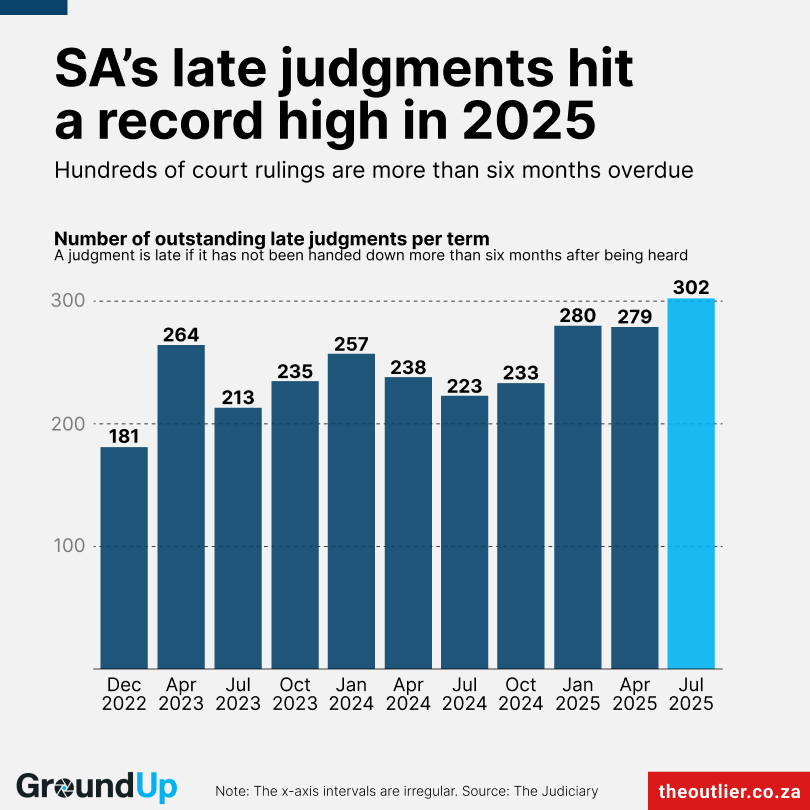
Our chart with GroundUp this week shows that the number of late outstanding judgments has risen from 181 in December 2022 to over 300 in July 2025, the latest term for which we have data. This data is taken from reports published, usually late, by the Office of the Chief Justice.
In terms of norms laid out for judges in 2014 by then Chief Justice Mogoeng Mogoeng, judges should hand down rulings within three months of judgment being reserved. However, over time, the official definition of a late judgment has morphed into six months.
Mbekezeli Benjamin, writing in GroundUp a year ago, explained how a big part of the problem is the number of vacancies in various courts.
It is not only the judiciary that causes justice to be delayed. Every aspect of the system contributes to the problem.
South Africans are losing confidence in the justice system. There is an urgent need for the President, the Minister of Justice and the Chief Justice to recognise the situation for the crisis it is, and to take urgent steps to fix it.
- Read the full GroundUp editorial here.
Click here for a link to all references for this newsletter.