
The South African Wholesale Electricity Market (SAWEM) is a hot topic. As Saul Musker, the chief director of strategy and delivery support in the Presidency, said this week in a webinar about SAWEM, we are in the midst of “the most significant reform in the energy sector in South Africa’s history”. We’re rapidly moving away from relying on Eskom – a “vertically integrated monopoly” – to having a competitive electricity market.
We did get off to a slow start, said Musker. More than 100 countries have already unbundled their electricity utilities. But there’s no turning back now.
Two things stood out for me in the webinar: firstly the role of electricity traders was explained, showing just how much the electricity market has and will change, and secondly, a representative from Eskom Green explained its role in SAWEM (the recording is on EE Business Intelligence’s YouTube channel).
Shift from bilateral to trader-led deals
We already have more than 7GW of independent power capacity supplying wind and solar electricity to the grid through the government’s renewable procurement programme (REIPPPP), introduced in 2011. Eskom takes up those electrons via long-term power purchase agreements, usually 20 years.
Despite its success, the programme has structural limitations. The single-buyer model means that Eskom is the sole buyer for every contract. This creates a ceiling on the volume of investment the programme could absorb, since all financial risk ultimately flows back to Eskom and, by extension, to the state.
In 2021, the licensing threshold for generation was raised from 1MW to 100MW, then in 2022, the threshold was removed entirely, which meant any generator could build and sell electricity without a licence, removing the most significant regulatory barrier to private investment.
Developers moved quickly into bilateral power purchase agreements between a single generator and a single large off-taker, typically large commercial and industrial energy users, mining companies, or manufacturers with sufficient scale and sophistication to enter into long-term energy contracts.
In 2023, most of the private utility-scale projects (those above 5MW) that reached financial close did so under direct contracts between a generator and a single large off-taker, said Wayne Cowie, CEO of electricity trader EXSA. According to Krutham’s Policy to Power report produced for the South African Energy Traders Association earlier this year, 2.6GW of the renewable energy projects that reached financial close between 2023–2025 were backed by electricity traders.
Traders have unlocked a category of project that could not be financed under the bilateral model: projects where customer demand existed, but where no single off-taker was willing or able to commit to a 20-year contract.
Where a bilateral deal is a one-to-one relationship between a generator and a buyer, a trader aggregates many generators and many buyers. This changes the risk profile. For example, traders typically buy power from generators under long-term agreements, while offering shorter, more flexible contracts to their customers. They buy from different generators that use different technologies and in different geographies, so if a generator has an issue, or there is a weather event, or grid constraints, the electricity supply to customers doesn’t have to be disrupted. The trader sits between the generator and the customer, absorbing risk on both sides.
The role of Eskom Green
Eskom Green has been approved by the National Treasury as a ring-fenced subsidiary of Eskom Holdings, Khutso Sekgota, Eskom Green’s general manager for business development, said in the webinar.
It will focus on renewable energy – solar PV, wind, hydro, pumped storage, batteries and green hydrogen – and has approximately 14GW of projects in development. It is prioritising the “repowering” of Eskom’s retiring coal power stations, such as Hendrina and Camden, with commercially viable renewable investments, said Sekgota.
Most importantly, Eskom wants to be an equal market player in the competitive energy market operating under the same rules as independent power producers, he said. A private sector partnership framework is being developed to enable co-investment. The message was intended to reassure the market that Eskom Green is not a mechanism to reverse liberalisation, but an equal participant within it.
New private power projects
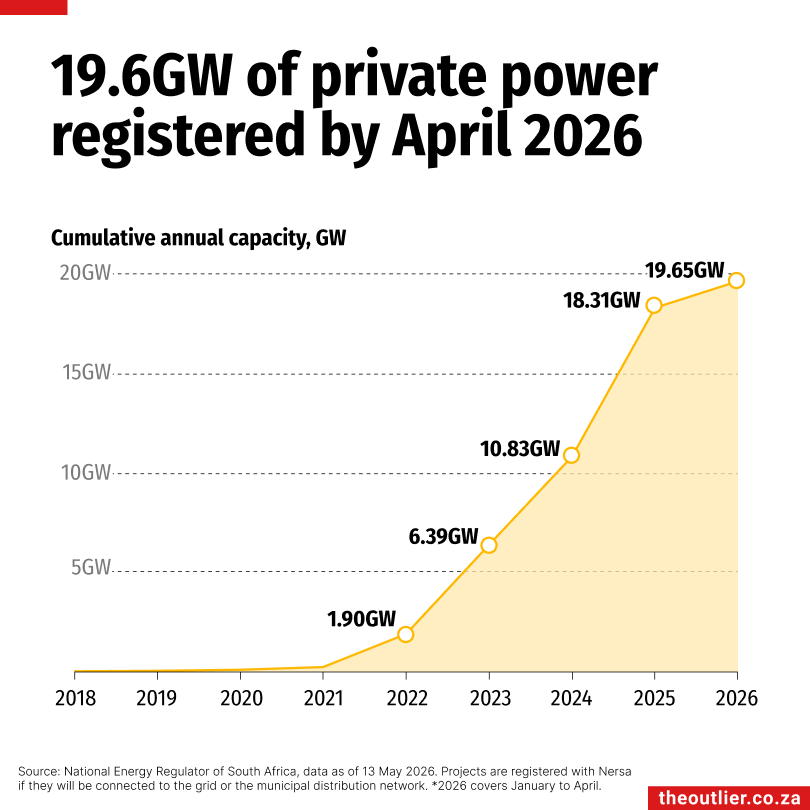
Private power projects registered with Nersa are inching close to 20GW, according to the latest information released by Nersa yesterday. In the first four months of 2026 alone, 132 new projects with a combined capacity of 1.34 GW were registered.
Six projects of 100MW or more have been registered so far this year. Four are solar projects and two are wind. Three are in the Free State, two in the Northern Cape and one in the North West. The projects are:
- Lengana Solar PV (250MW), Free State,
- Mulilo Kuruman Wind Power Phase 2 (240MW), Northern Cape
- Volta PV (150MW), Free State
- Lerato Solar Power Plant (120MW), North West
- FS Stinkputs Wind (240MW), Northern Cape
- Nyala Solar Power Plant (240MW), Free State
RENEWABLE PIN-UP
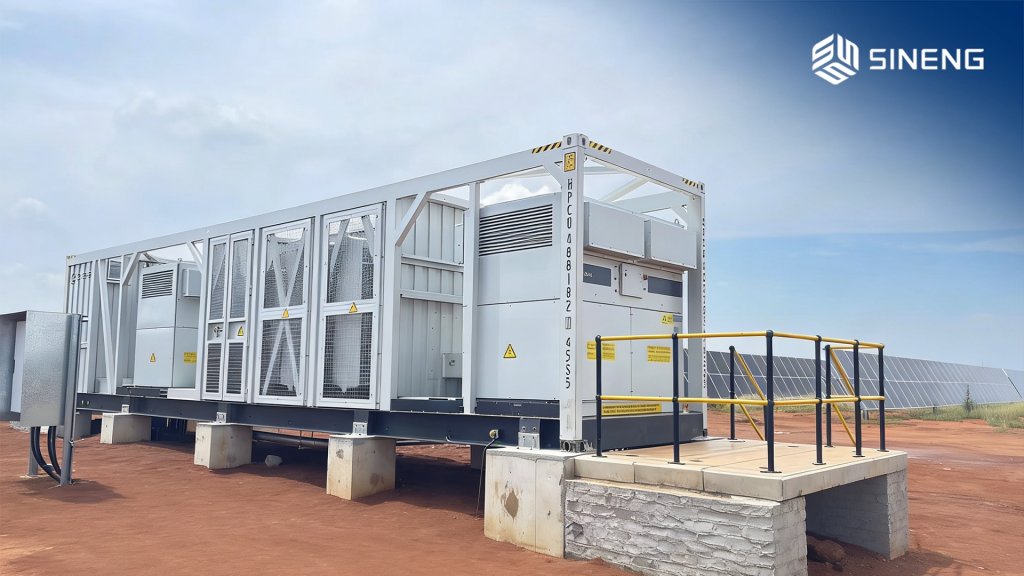
Sineng’s inverter system equipped to work amidst dust and sandstorms withstanding temperatures from -30ºC to 60ºC. (Photo: Sineng)
The 120MW Doornhoek PV Solar Project connected to South Africa’s national grid on 26 April 2026. It is expected to generate over 325GWh of electricity annually. That’s enough to power roughly 97,000 homes and offset 330,000 tonnes of CO₂ emissions a year. The plant is located in one of the more arid regions of South Africa. Its inverters are engineered to withstand extreme temperatures and sandstorms, making it well-suited to its environment.
Vital statistics
Doornhoek PV Solar Project
Location: Klerksdorp, North-West Province
Area covered: 200 hectares
Capacity: 120MW
Expected annual generation: 325GWh
Estimated offsetting of CO₂ emissions: 330,000 tonnes
Inverter units: 19 central inverter skids
Operating temperature for inverters: −30°C to 60°C
REIPPP bid window: 6
Grid status: Grid connected
Project owner: AMEA Power
NEWS WRAP
⚡️ African Rainbow Energy, founded by billionaire Patrice Motsepe, has increased its control of the Sola Group from 41% to 83%. Sola was one of the first independent power producers awarded a generation licence for a private-utility scale renewable power plant. Sola’s Adams solar plant, which was commissioned in 2021, supplies power to Amazon Web Services through a wheeling deal.
🔋 Eskom and Energy Vault have signed a strategic development agreement to deploy a grid-scale gravity energy storage system at the Hendrina Power Station in Mpumalanga, starting with a 25MW/100MWh installation that uses recycled blocks made from coal ash — each weighing 25-30 tonnes. Gravity energy storage works by using spare renewable power to lift heavy blocks up high. When electricity is needed, the weights are lowered, and their fall spins a generator to make power. It’s a clean, long-lasting alternative to batteries.
🌍 More than $11-billion in clean energy commitments were announced at the France-Africa Summit in Nairobi on 12 May, with deals spanning six countries. TotalEnergies pledged $2-billion for a renewable energy project in Rwanda and $400-million for clean cooking fuel across Kenya, Uganda and Tanzania; Global Telecom committed $350-million to a 250MW solar plant in Zambia; and Meridian announced $200-million to double the capacity of Kenya’s Kipeto wind farm to 200MW. Électricité de France (EDF) added a 2-gigawatt hydropower project to a portfolio that already includes the operational 1.5GW Mphanda Nkuwa scheme in Mozambique, while Kenya Airways and Rubis Energy agreed to build Africa’s first sustainable aviation fuel facility.
💨 South Africa has a 17GW pipeline of wind projects entering construction in the next five years, according to the recently released Global Wind Report 2026.
📋 South Africa’s national energy regulator (Nersa) registered 112 generation facilities in Q4 of the 2025/26 financial year(January to March 2026). The registrations total 1,327MW and estimated R28.22-billion in investment. Solar PV dominated the registrations, with the Western Cape (41) and Gauteng (27) hosting the most projects, while the Northern Cape, Free State and North West led on installed capacity and investment value. Of the 112, 69 connect to Eskom (1,307MW) and 43 to municipal networks (20MW).
☀️ Redefine Properties now has 62.23MWp of installed rooftop solar PV across its properties, according to its interim results for the period ending February 2026. Most of the solar is installed on its retail and shopping properties, accounting for nearly 48megawatt-peak (MWp), followed by industrial (8.23MWp) and office buildings (6.21MWp). The company also wheeled roughly 18.5MWh of renewable electricity through short-term agreements.
☀️ Anthem’s 20MW Tsamela solar PV project in Eswatini reaches finanacial close.
EVENTS
💻 Webinar: The EU’s Carbon Border Adjustment Mechanism (CBAM), a tool to put a fair price on carbon emitted during the production of carbon-intensive goods that are entering the EU, and to encourage cleaner industrial production, started from 1 January 2026. EE Business Intelligence is hosting a workshop that will provide an opportunity for South African businesses and industry representatives to engage directly with the European Union on the practical rollout of CBAM. Register here.