On Wednesday the IEC released a list of candidates cleared to run in the 4 November local government elections. Officially there are 136,790 candidates. In 2021 there were 95,427 candidates. There are also 75 parties contesting the City of Johannesburg, 70 in Tshwane and 69 in eThekwini. The City of Cape Town has 55 parties contesting.
The most notable datapoint though is how many candidates are standing in multiple wards. Not just in a couple of wards but sometimes hundreds of wards. At the top of the list are two candidates listed 135 times. They are not alone: there are 3 other candidates listed 130 times or more.
We’ve put together an interactive list of the candidates that appear in multiple wards.
Standing in multiple wards is not against the electoral regulations even if it does feel like a mockery of the process. Unofficially it seems to be an attempt by parties to secure a larger PR vote count as all votes cast for a party on the PR ballot and for that party’s candidates on ward ballots are added together.
🤜 The Outlier is mostly supported by you, the reader. If you aren’t yet a supporter please consider subscribing or making a donation today. Thank you to Graham, Ziyanda and Rachel who recently became Outlier members 🙏. You make this possible.
🤦♀️ Man standing
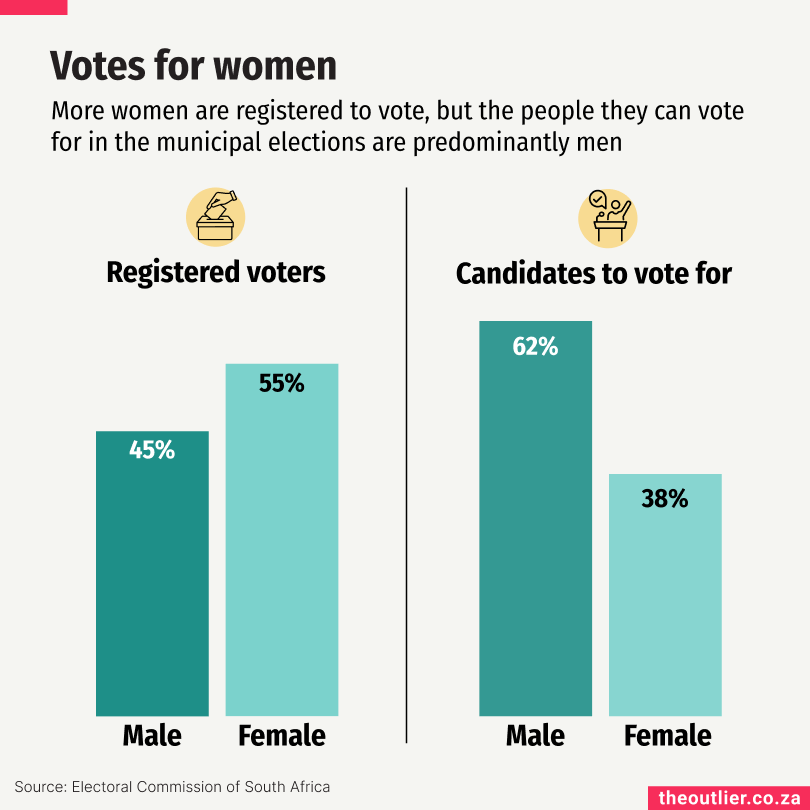
The candidate list for the local government elections was published this week and the people who are standing for election are mostly men. It’s a roughly 60:40 split. The people who have registered to vote, on the other hand, are mostly women, at 55%.
Why does this matter? Firstly, one could ask whether the political parties are paying sufficient attention to issues that are priorities for women. For example, polling by the Institute of Race Relations (IRR) between 2021 and 2026 found that 25% of women named abuse of women and children as a top priority compared with 8% of men.
Housing was named by 15% of women and 3% of men. Household security-related issues consistently carry more weight among women than men, according to the IRR’s report. This gives the ANC a persistent advantage and it’s women voters that keep the ANC ahead of the DA, says the IRR in the key findings.
💦 Foul flows
Untreated sewage entering waterways and the sea can spread diseases, make drinking water more difficult to treat, and can harm river ecosystems.
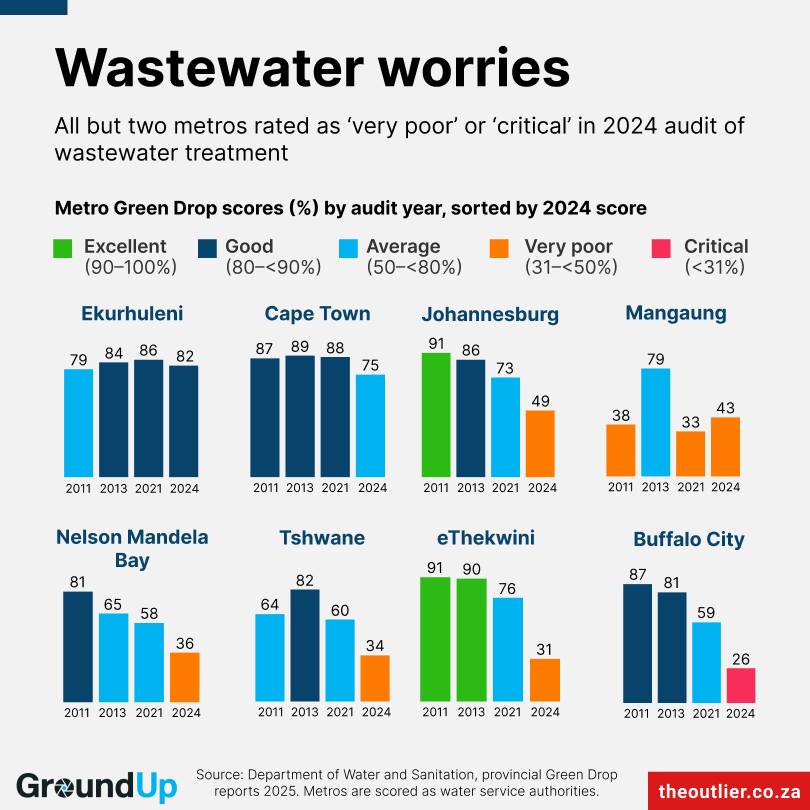
But in almost every metro in South Africa, wastewater treatment has deteriorated between 2021 and 2024, according to the 2025 Green Drop report issued by the Department of Water and Sanitation.
Ekurhuleni got the highest score of any metro in 2024, at 82%, down from 86% in 2021, and was the only one rated “good”. Cape Town, at 75%, dropped from the “good” to “average” category and recorded its lowest score so far.
Johannesburg’s score has dropped in every audit cycle, scoring an excellent 91% in 2011, then a “good” 86% in 2013, “average” 73% in 2021, and “very poor” 49% in 2024. The city has experienced serious failures and is exceeding the design capacity of its treatment works.
Mangaung is the only metro that has seen an improvement in scores between 2021 and 2024, but the score is still low at 43%. Not enough preventative maintenance is being conducted, and its treatment capacity is limited. GroundUp reported earlier this month that none of the 13 works is functioning properly, that screw pumps are missing, and that effluent flows into Maselspoort Dam, a drinking water source.
🙏 Produced in partnership with GroundUp News. Read the full story.
📚 Reading room
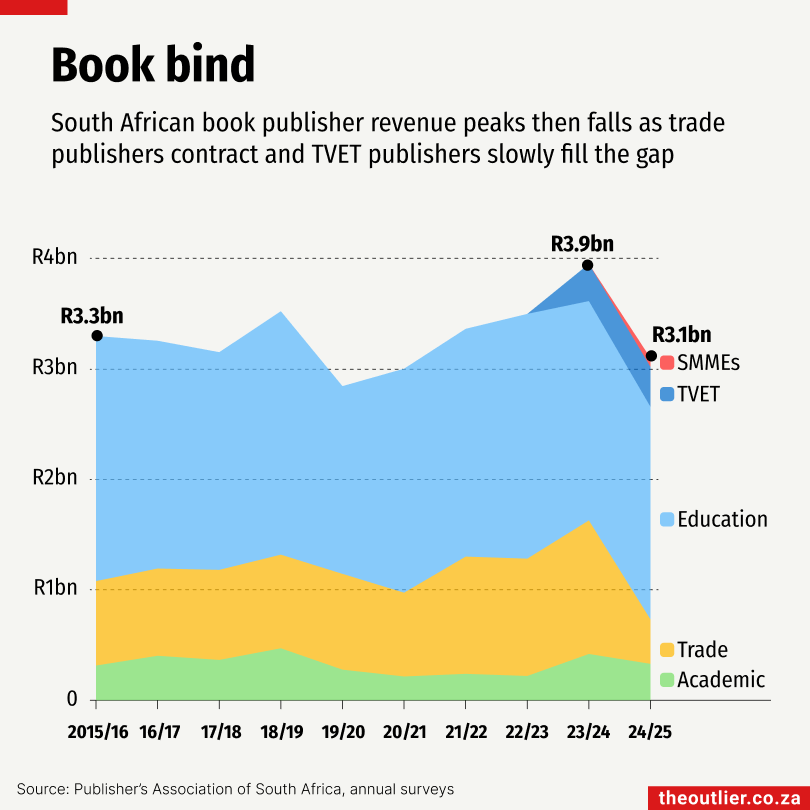
South Africa’s book publishing industry pulled in R3.1-billion in 2024/25, down 18% on the previous year. The Publisher’s Association of South Africa attributes a large part of that decline to trade mergers during that period. Jonathan Ball Publishers absorbed both NB Publishers and Van Schaik Publishers in 2025 resulting in a significant dip in reported revenue between 2023/24 and 2024/25 as only one entity reported.
But zoom out and in 2015/16, the industry also turned over roughly R3.3 billion. So almost ten years later and the top line hasn’t moved.
Education publishing remains king at 62% of revenue, and still overwhelmingly print (94%) and English (77%). Digital hasn’t taken off and has stuck around 3-6% of sales for years despite government e-library promises. Academic publishing keeps shrinking (-21% this year), squeezed by piracy and hybrid learning.
TVET publishing was added to the list in 2023 and now accounts for roughly 7% of revenue or R362 million, almost entirely print, and almost entirely government-procured through colleges.
And then there’s the SMME layer: 26 small publishers, R80.5 million in turnover, most surviving on under R1 million a year. They punch above their weight on language diversity — nearly 30% of their titles are in African languages, versus 12% of big-publisher revenue.
🚽 Longer drop
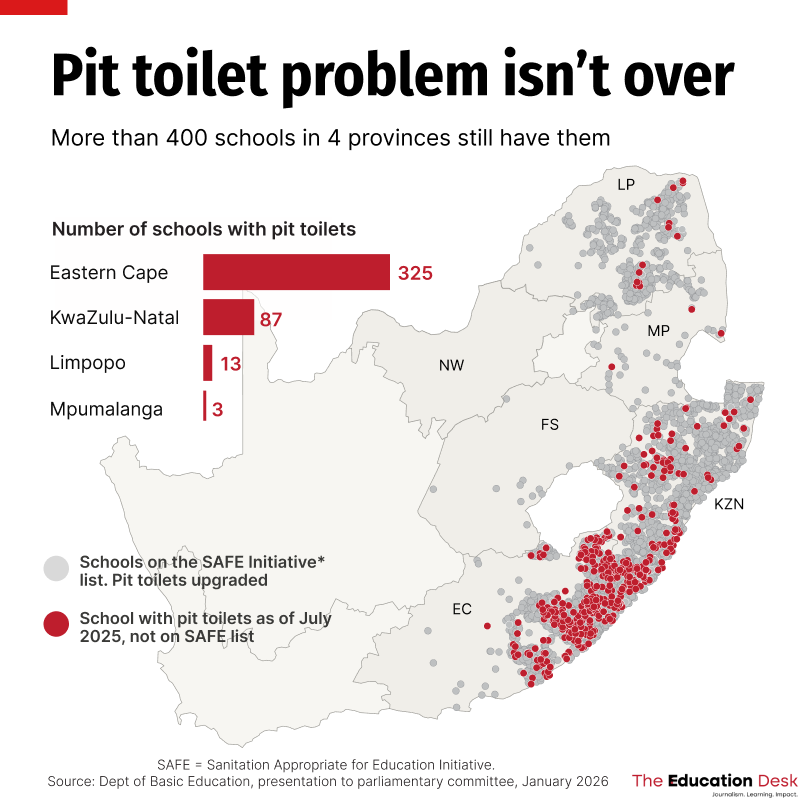
Contrary to reports the pit toilet crisis in schools has not been fully resolved. It took seven years to replace pit toilets at the 3,373 schools across the country through a programme called the Sanitation Appropriate for Education (SAFE) Initiative. But, in January, the Department of Basic Education (DBE) revealed to parliament that at least 400 more schools, that were never identified by SAFE, are still using pit toilets. These are the red dots on the chart, and appear concentrated in KZN and the Eastern Cape.
Keeping track of schools with pit toilets is complicated. There are multiple lists which don’t tally, or have duplications and omissions.
Related: Interactive map of Safe Initiative schools, Section27’s Michael Komape Sanitation Progress Monitor.
🙏 Produced in partnership with The Education Desk