🏠 Pay parity
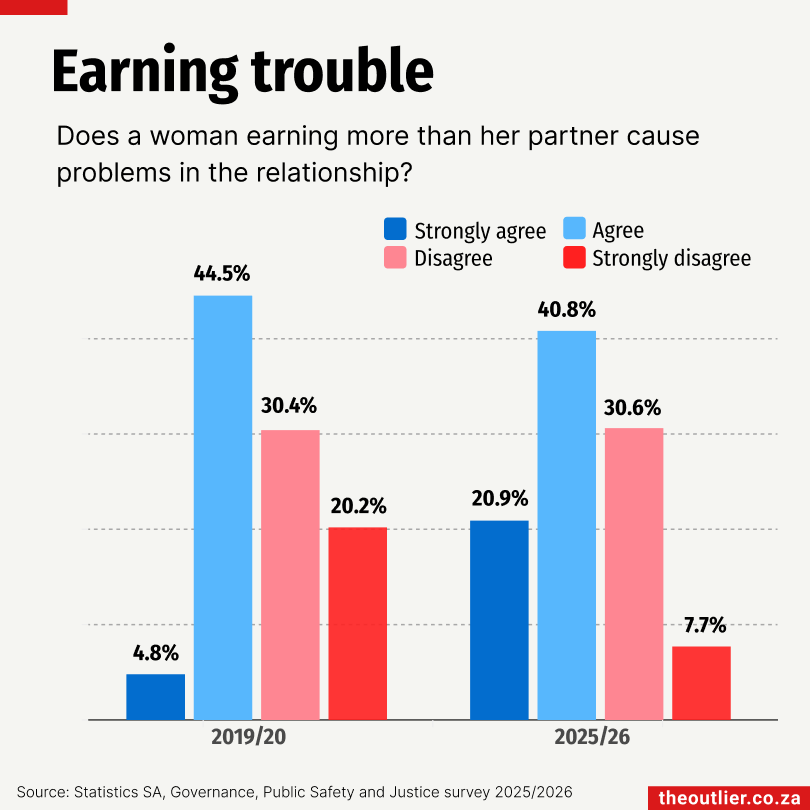
Would you have a problem with your significant other earning more than you? The latest Statistics SA Governance, Public Safety and Justice survey says that you might.
In the last six years the number of people who agree that women earning more than their male partner can cause problems in that relationship has increased from 49.3% in 2019/20 to 61.7% in 2025/26.
More people than ever strongly agree that this is a truth, going from only 4.8% of people strongly believing this to be true in 2019 to 20.9% believing it’s true in 2026. And the number of strong opposers has dropped radically from 30.4% in 2019 to just 7.7% in 2026.
🦏 Horns and all
South Africa has the world’s largest rhino population. At the end of 2025 there were at least 15,096 animals – 12,531 white rhinos and 2,565 black rhinos – according to the Department of Forestry, Fisheries and Environment’s estimates (DFFE).
Even though hundreds of rhinos are shot every year for their horns, the rhino population has actually grown by 5% since 2024, says the DFFE.
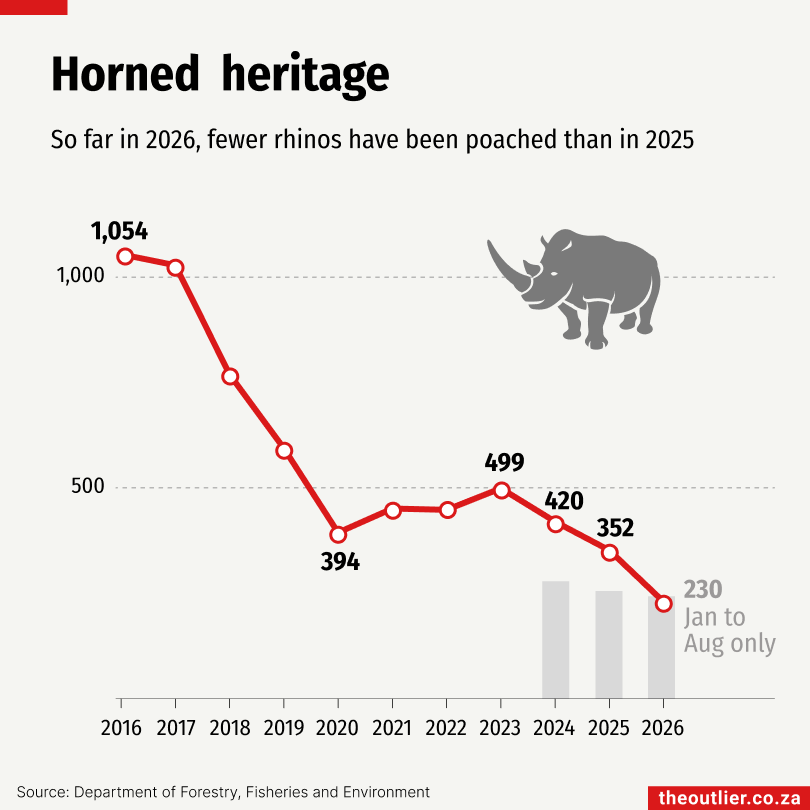
The number of rhinos poached per year has been decreasing since 2023 and is significantly lower than 10 years ago, when more than a thousand rhinos were killed.
Between January and August this year, 230 rhinos have been poached (114 of them in the Kruger National Park). This is 18 fewer than in the first eight months of 2025 and 42 fewer than the same period of 2024.
In 2025, poaching accounted for 2.2% of South Africa’s rhino population, below the estimated 3.5% population sustainability threshold, says the DFFE.
🏭 Smokin’
Even though South Africa produces about 1% of the world’s greenhouse gases, Climate Action Tracker has rated South Africa’s targets as “insufficient”, projecting that if every country followed the same approach, warming would pass 2°C and could reach 3°C.
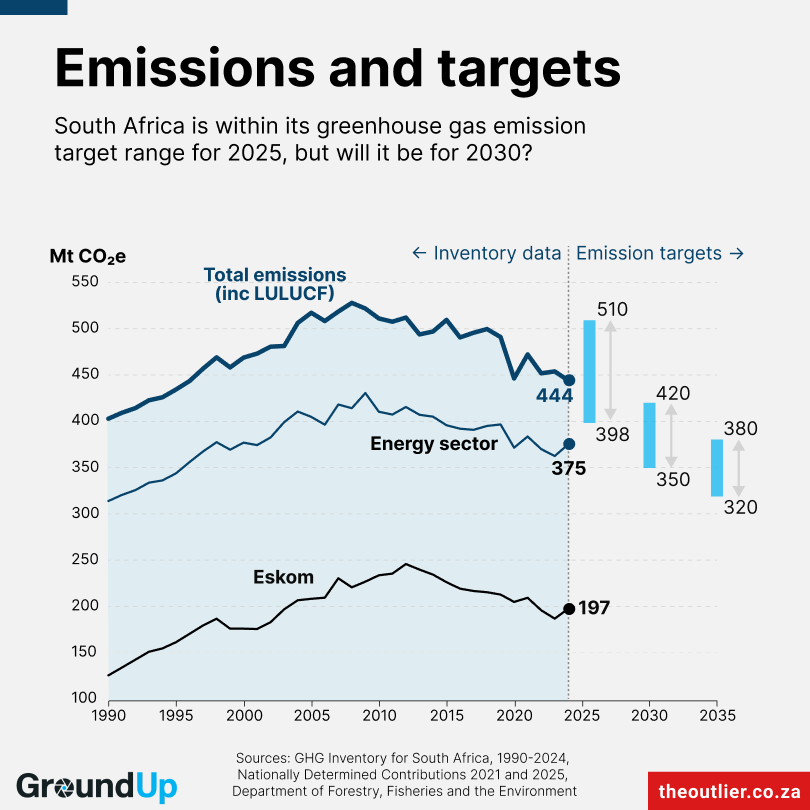
The country’s emissions peaked in 2008 and have been decreasing unevenly since. This is not because of intentional greening efforts: the Presidential Climate Commission suggests the drop in emissions is likely due to economic stagnation and load shedding.
The energy sector alone emitted 375Mt in 2024, which is more than the whole lower target for 2030 (350Mt). In order to reach the top of the 2030 range, emissions must fall by another 24Mt. To reach the bottom of the range, they must fall by 94Mt.
It’s not guaranteed that this will happen. The government’s electricity plan, the IRP 2025, retires 8GW of coal by 2030, but only if 6GW of new gas power is running by then, which is uncertain. It also considers keeping five big stations open ten years past their 50-year life. Eskom has already moved the closure of five coal stations to 2030 due to delays in getting private power online.
🙏 Produced in partnership with GroundUp News. Read the full story.
🕹️ Big gaming
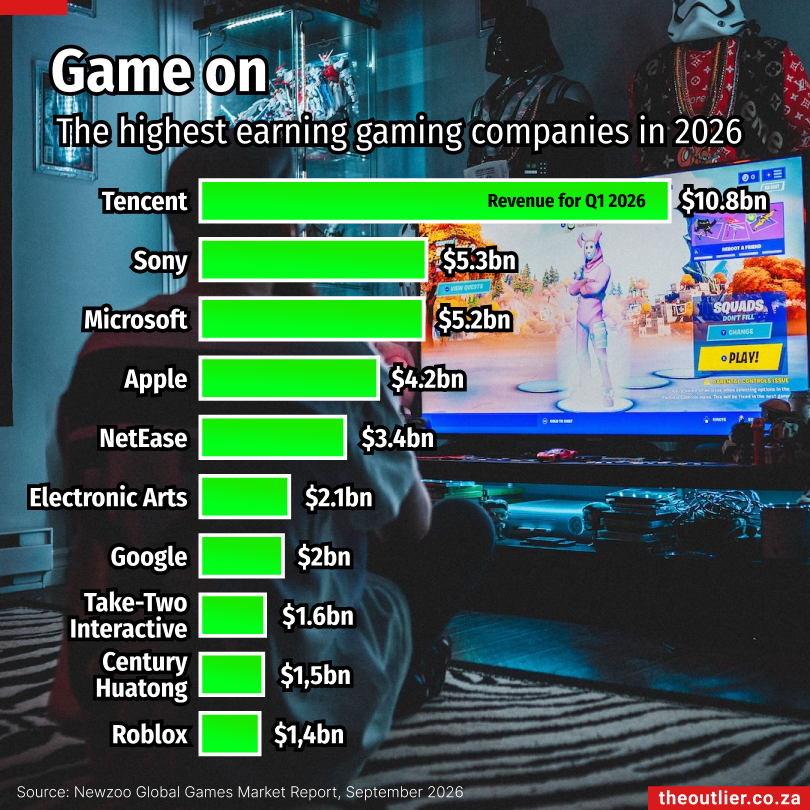
Who do you think is the biggest gaming company? Most people would guess Sony, Microsoft or Nintendo. But the real answer is Tencent, a Chinese tech company best known for the messaging app WeChat. In the first quarter of 2026 alone, Tencent made about $10.8-billion from games, double that of Sony and Microsoft at around $5-billion each.
Video gaming is a $213.9-billion industry in 2026, with 3.7-billion players worldwide. On average, players spend an average of $129.60 on gaming annually.
Mobile is by far the biggest of the sector. 3.1-billion people play on their phones and mobile brings in 57% of total annual revenue, which isn’t surprising given the number of people who have access to a smartphone. PC (977-million players) and console (651-million players) account for 22% and 21% of revenue respectively.
Tencent is easy to overlook because its name rarely appears on the games it profits from. However Tencent has significant assets in different gaming companies. It owns Riot Games, makers of League of Legends and Valorant, it owns a stake in Epic Games, makers of Fortnight, as well as a more mobile-focused companies such as Supercell (Clash of Clans, Clash Royale) and PUBG Mobile. Tencent is also the developer for Honor of Kings, the worlds highest-grossing mobile game.
There is also a local angle to this: Publisher Media24 is owned by Naspers which has a roughly 23% stake in Tencent via its Prosus subsidiary. Naspers originally bought into Tencent in 2001 for US$32-million.